
Curate William Henry Parsons (1865-1937)
The following information and edited extracts are from the Parsons Family website – http://www.parsonsfamily.co.uk/whparsons.php – [We have tried asking permission to use this extract, but have been unable to contact anyone through the parsonsfamily.co.uk website. – D]

William Henry Parsons 1865-1937
An interesting insight into St Jude’s church at the end of the 19th century is given in a contribution written shortly before his death to St Jude’s church magazine by William Henry Parsons (1865-1937), whose first appointment as a curate was at that church.
St Jude’s at that time had a parish population of 6000 and the Rev TG Watton of St Jude’s had “a full church of working and middle-class people, and he is one of the most beloved clergy in Birmingham.”
William was ordained in Worcester Cathedral on 2 March 1890 and the next day, his first in Birmingham, he went straight to work addressing the Mothers’ Meeting at Inge Street Mission Hall. His article for the church magazine gives a real flavour of an active church one of the central wards of the city at the end of the 19th century.
“Parts of the parish were rather slummy, and some of the courts were certainly unsavoury. Many of the houses in Hurst Street, Inge Street and Thorp Street were occupied by foreign Jews. There was much poverty, for old-age pensions and widows’ pensions were then unknown. I knew poor widows who made matchboxes at home, and others who sewed buttons on cards, and had to work twelve hours a day to make a bare living. It is good to know that such conditions do not exist to-day.
“The congregation on Sundays consisted largely of non-parishioners, some of whom came long distances, from Moseley, Small Heath, Sparkbrook, Selly Oak and Edgbaston. The Vicar was himself a Birmingham man, and thoroughly understood his people, and there was a family feeling such as I have not known in any other parish. The service was very simple in all its details. A mixed choir sat by the organ at the West end. The reading desk faced the people. In many churches today there are two distinct congregations, one in the morning and one in the evening; but at St Jude’s the great majority were in the habit of coming twice every Sunday.
“I was given charge of a Men’s Bible Class, and had about fifty men every Sunday afternoon. Mr Fred Roberts had a Bible Class for young men, and his brother, Mr William Roberts, was Superintendent of the Boys’ Sunday School. The Vicar had a Bible Class for men and women every Monday evening, and had a wonderful attendance. We had a service in church on Wednesday evenings and a Mission Service at Inge Street, on Thursday evenings. A fortnightly working party was held in the Mission Hall at which the clergy usually looked in for tea. Once a year a Sale of Work was held on behalf of the upkeep of the Mission Hall. We had a large staff of devoted Sunday School teachers, both at Hill Street and at Inge Street. The Infant School was held at Inge Street, and the numbers were over 300. A Girls’ Sewing Class was held at Inge Street on Tuesday evenings, and a Mothers’ Meeting on Monday afternoons.
“The Vicar laid great stress on the value of visiting. Every Monday morning he met his staff, curate, lay reader and lady worker (called in those days “Bible woman”) in the Vestry, when he received reports of their visiting during the past week, and arranged their work for the following week: There were always many sick to be visited, tuberculosis being very common. This was no wonder, considering the many back-to-back houses then existing. No parish was ever visited more thoroughly and systematically. I soon got to know every street and court, and most of the people.
“Like most places the city has seen great changes. The people now are better housed, better fed and better educated. When I took weddings at St Jude’s I usually had to put the question in the vestry, “Can you write?” and frequently the answer would be “No.” If you could see the registers of 1890 – 1892 you would find many crosses instead of signatures, “John Smith X his mark.” These people were born before the Education Act of 1870.
“I remember one interesting baptism at St Jude’s. An infant had been found on December 21st (St Thomas’ Day) lying on the Church doorstep. Nobody claimed it, so a kind-hearted couple who had no children of their own, adopted it. They brought it to be baptised, and the name given was “Thomas St Jude,” thus commemorating the date and place of its discovery.
“I remained at St Jude’s until Mr Watton left for Richard’s Castle in 1892, and was in charge of the parish for three months until the new Vicar arrived. I then became Curate of St Martin’s under Dr Wilkinson. I can truthfully say that the two-and-a-half years spent at St Jude’s were among the happiest days of my life.“
St Jude’s Church
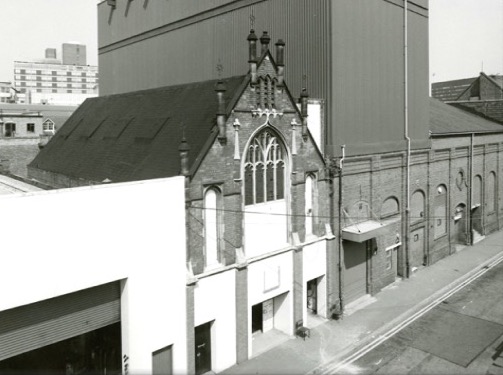
St Jude’s, Tonk Street, now Hill Street in the City Centre, was a building of brick designed in Early English style by Orford & Nash, and consisting of a chancel, nave and aisles. It was a Commissioners’ church. With a grant by the Commissioners of only £500, the bulk of the finance must have been raised elsewhere.
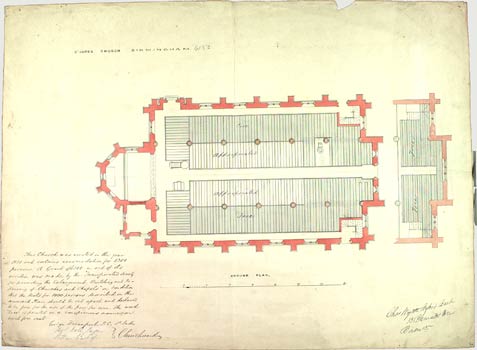
Building began in 1847, a parish already having been assigned out of those of St Martin’s and St Philip’s two years previously. Services were held in the National school in Pinfold Street until the church was consecrated in 1851. The church had 1300 sittings, of which 1000 were free. The parish was further enlarged out of St Martin’s in 1885 serving a population of some 6000 people.
St Jude’s was the parish church of a district which included Greens Village, The Hinkleys, The Froggery and The Rookeries, districts of the very poorest parts of Birmingham. From the mid-18th to the mid 19th century, this was a notorious slum area off Hill Street of crowded back-to-back houses many occupied by an immigrant Irish population. The living of St Jude’s, only £150, was one of the poorest in the town.

By 1879 the church building, badly in need of care and attention, was renovated. By this time the area had been improved by the demolition of the many rookeries surrounding it as a result of the building and expansion of New Street Station from 1852. The term ‘rookery’ was used colloquially in the 19th century of dilapidated tenements and slum dwellings, the haunts of thieves and crooks.
The population of the central wards of Birmingham gradually decreased; by 1943, the population of St Jude’s parish had dropped to less than 2500 and it continued to fall after World War 2.

By the 1960s the area was under redevelopment especially for retail and commerce, and there were almost no residents living within the parish. The church building was in a poor state of repair and the final service at St Jude’s was in 1967; it was demolished in 1971.

 hurst-street.com