
Sherlock Street
Birmingham’s first historian, William Hutton wrote:
“About the year 1730, Thomas Sherlock, late Bishop of London, purchased the private estate of the ladies of the manor, chiefly land, about four hundred per annum. In 1758, the steward told me it had increased to twice the original value. The pious old bishop was frequently solicited to grant building leases, but answered, his land was valuable, and if built upon, his successor, at the expiration of the term, would have the rubbish to carry off:, he therefore not only refused, but prohibited his successor from granting such leases,. But Sir Thomas Gooch, who succeeded him, seeing the great improvement of the neighbouring estates, and wisely judging fifty pounds per acre preferable to five, procured an act in about 1766, to set aside the prohibiting clause in the bishop’s will. Since which, a considerable town may said to have been erected upon his, now about £2400 per annum.”
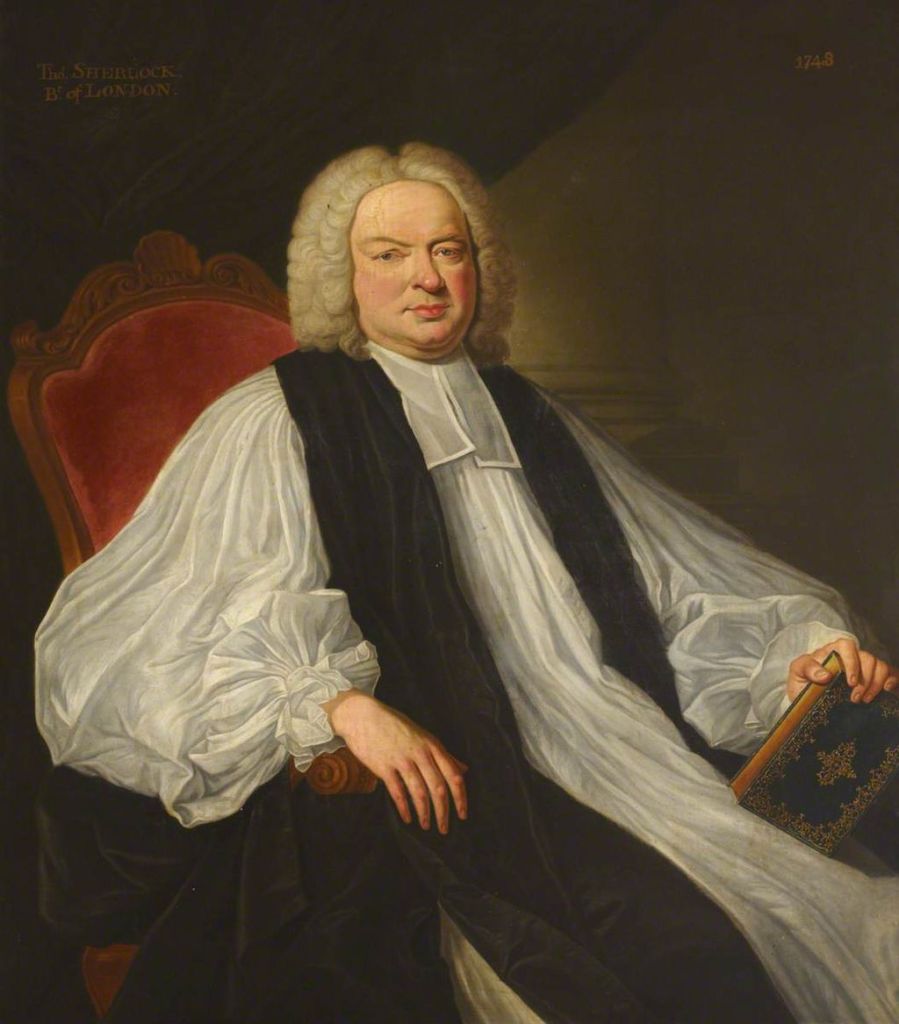
Thomas Sherlock (1678 – 1761) was a British divine who served as a Church of England Bishop for 33 years. He is also noted in church history as an important contributor to Christian apologetics.
Born in London, he was the son of the Very Revd William Sherlock, Dean of St Paul’s. He was educated at Eton College and St Catharine’s College, Cambridge. In 1704 he succeeded his father as Master of the Temple. Sherlock died in 1761 and is buried in the churchyard of All Saints Church, Fulham, Middlesex.
The sisters referred to by Hutton were of the Marrow family, which held the lordship of the manor of Birmingham since 1555. With no male heir to their lands, the four sisters sold the private estate to Bishop Sherlock, hence Sherlock Street and Bishop Street. Sherlock’s sister, Mary was his heir. She was married to Sir Thomas Gooch, who lived at Benacre Hill in Wrentham, Suffolk (near to Lowestoft) — these places give rise to Gooch Street, Benacre Street, Wrentham Street and Suffolk Street. Sir Thomas was aware of the growth of Birmingham and realised the potential in the development of the land he had inherited. As Hutton noted, he set aside Sherlock’s wishes in his will by an act of parliament that allowed him and his sons, Thomas, William and John and their guardians to grant building leases of certain land.
Since the mid-nineteenth century, the Gooch Estate in Birmingham has been administered locally by James Lister Lea. Some of the lands have been sold off, but much remains in the possession of the Gooch family. Its members have played little part in the life of Birmingham, although the present Back to Backs Museum run by The National Trust in Hurst Street/Inge Street is a property donated by the Gooch Estate.


 hurst-street.com